
High-Energy Nuclear Theory
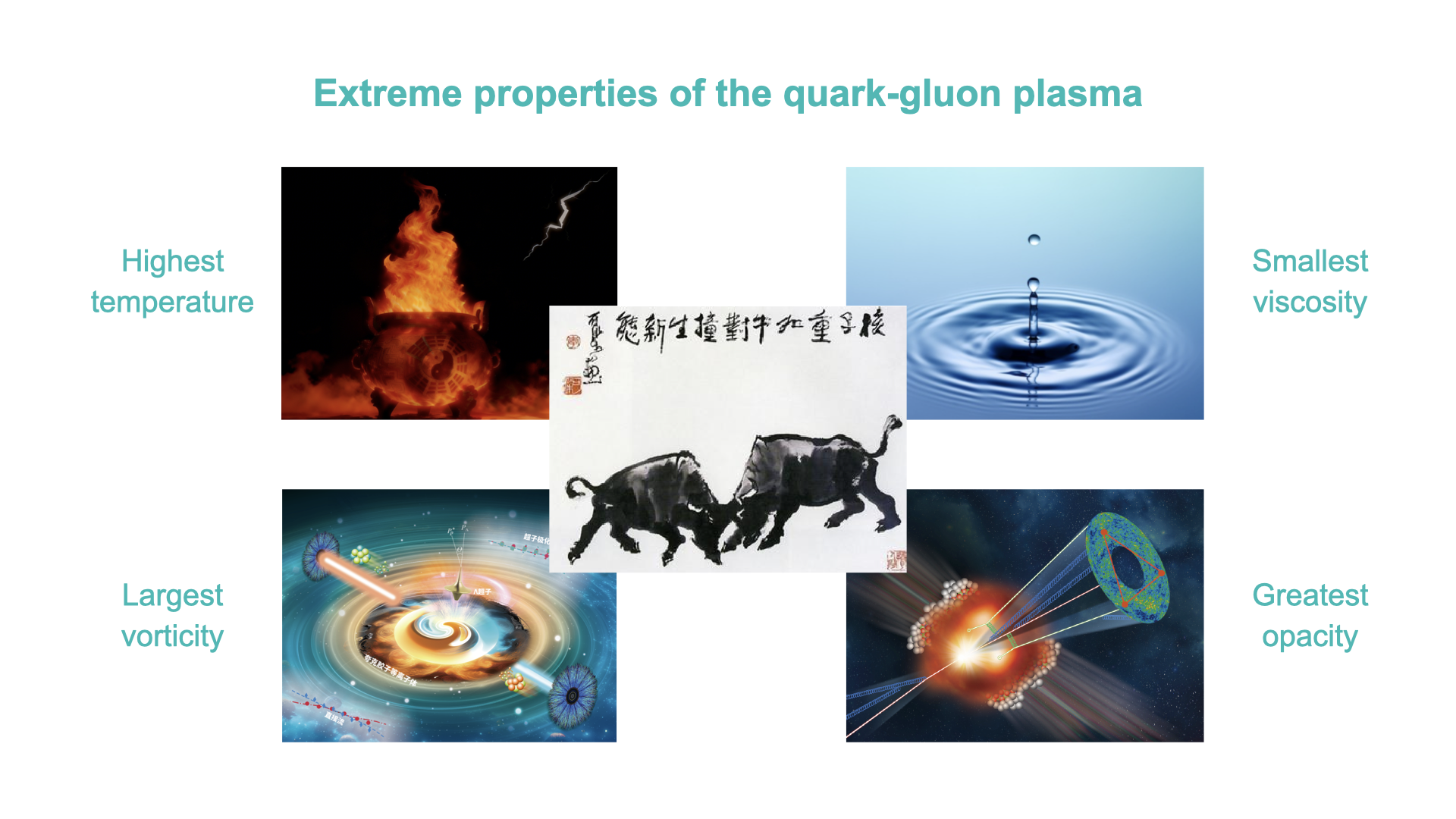
When nuclear matter is heated beyond two trillion degrees (300 million times of the surface temperature of our sun), it becomes a new state of matter called Quark-Gluon Plasma (QGP). Our universe existed in the state of QGP microseconds after the Big Bang. Today, the only way to create QGP in laboratory is accelerating heavy nuclei towards the speed of light and colliding them, known as relativistic heavy-ion collisions, also called “Little Bang”. The QGP is a strongly interacting matter composed of quarks and gluons, displaying many extreme properties: it is the matter with the highest temperature, smallest specific viscosity, fastest vorticity, and greatest opacity one can create in laboratory.
We are developing diverse approaches to probe the QGP properties, such as Quantum Chromodynamics (QCD) theory, transport theory, Monte-Carlo simulation and machine learning techniques. Research topics include high-energy jet and heavy quark energy loss inside the QGP, jet-induced QGP excitation, hadronization mechanism of quark matter, etc. Our goal is to establish a comprehensive theoretical and computational platform that bridges theoretical predictions and experimental measurements, deepening our understanding of the strong nuclear force and the state of nuclear matter under extreme conditions.
Welcome to our team!
A brief introduction of relativistic heavy-ion collisions and QGP can be found here.